oberon
Recently added items

Private Label Diamond Jewelry Manufacturer: No MOQ, Your Branding, Fast Turnaround

Honestly, the question we get asked most about private label diamond jewelry has nothing to do with price or minimums. It’s usually just: can you put our name on it? Yeah. And most of the time that costs little to nothing extra.

Half the brands that ask call it white label, the other half say private label. We don’t really distinguish between the two — either way it means the piece gets made here but wears your name, not ours.

Private Label vs White Label: What’s Actually Different

If you want the technical version: private label usually means you had some say in the design, even a small one — a shape, a setting, something that’s actually yours. White label, by contrast, is more hands-off, closer to picking something ready-made and putting your name on the box. In practice though, most brands we work with end up somewhere in the middle of that, and truthfully it doesn’t matter much which word you use. Either way, what matters is whose name goes on the hallmark, and how small you can start.

Private Label Diamond Jewelry: Can We Hallmark With Your Brand Name?

Yes. It’s honestly one of the more painless parts of working with us — we stamp your brand name into the hallmark instead of ours, and it usually doesn’t add much, sometimes nothing, to the cost. We don’t treat it as an upsell, either. Instead, it just happens by default once you tell us it’s for your brand.

You Don’t Need a Full Catalogue to Start a Private Label Diamond Jewelry Range

A lot of people assume starting a private label range means committing to a whole collection right out the gate — a dozen SKUs, enough stock for a season. But it doesn’t work like that here. Instead, start with a few pieces and see what actually sells under your name before you commit to more.

No MOQ Applies to Private Label Diamond Jewelry Too

Same rule as everything else we make: no minimum order. So it doesn’t matter if it’s a one-off custom piece or the start of a proper private label range with your branding on it — either way, one or two pieces is genuinely enough to get going.

Turnaround: Same as Our Standard Custom Orders

Branding doesn’t add time to the process. So once an order’s confirmed, it’s 8 to 9 business days to produce, then another 7 to 8 business days shipping — about three weeks door to door, same across Australia, the US, UK and Canada.

What to Send Us to Get Started

  • Your brand name or logo — for the hallmark, and packaging if you want that too.
  • Anything you’ve already got. A sketch, a Pinterest board, even a photo of something close to what you want. Doesn’t need to be polished.
  • How many pieces to start with. No minimum, so this is really just whatever makes sense for you right now.
  • Natural, lab-grown, or a mix. Same as any order — you’re not locked into one. Either way, stones come with GIA or IGI certification regardless of whose name is on the hallmark.

Frequently Asked Questions

Do you offer private label and white label diamond jewelry manufacturing? Yes to both — we don’t really separate the two in how we work.

Can you hallmark pieces with our brand name? Yep. Usually at little to no extra cost, and it’s standard, not a special request.

Do we need a full catalogue or product range to start? No. A handful of pieces is plenty to start with.

Is there a minimum order quantity for private label or white label orders? No MOQ — same as every other order we run.

Does private label take longer to produce than a normal order? No. Still 8–9 business days to produce, then 7–8 business days shipping — about three weeks total, same across Australia, the US, UK and Canada.

What’s the difference between private label and white label jewelry? Private label means you had some input into the design. White label, by contrast, is closer to a ready-made piece that just gets your name on it. Most orders land somewhere between the two, and either way, we treat them the same.


Want your name on it? Get in touch and we’ll talk through hallmarking, order size and timing — or have a look at the full range lo first if you’d rather browse before reaching out.
Wholesale Diamond Jewellery Supplier for Australia: Custom Designs, No MOQ

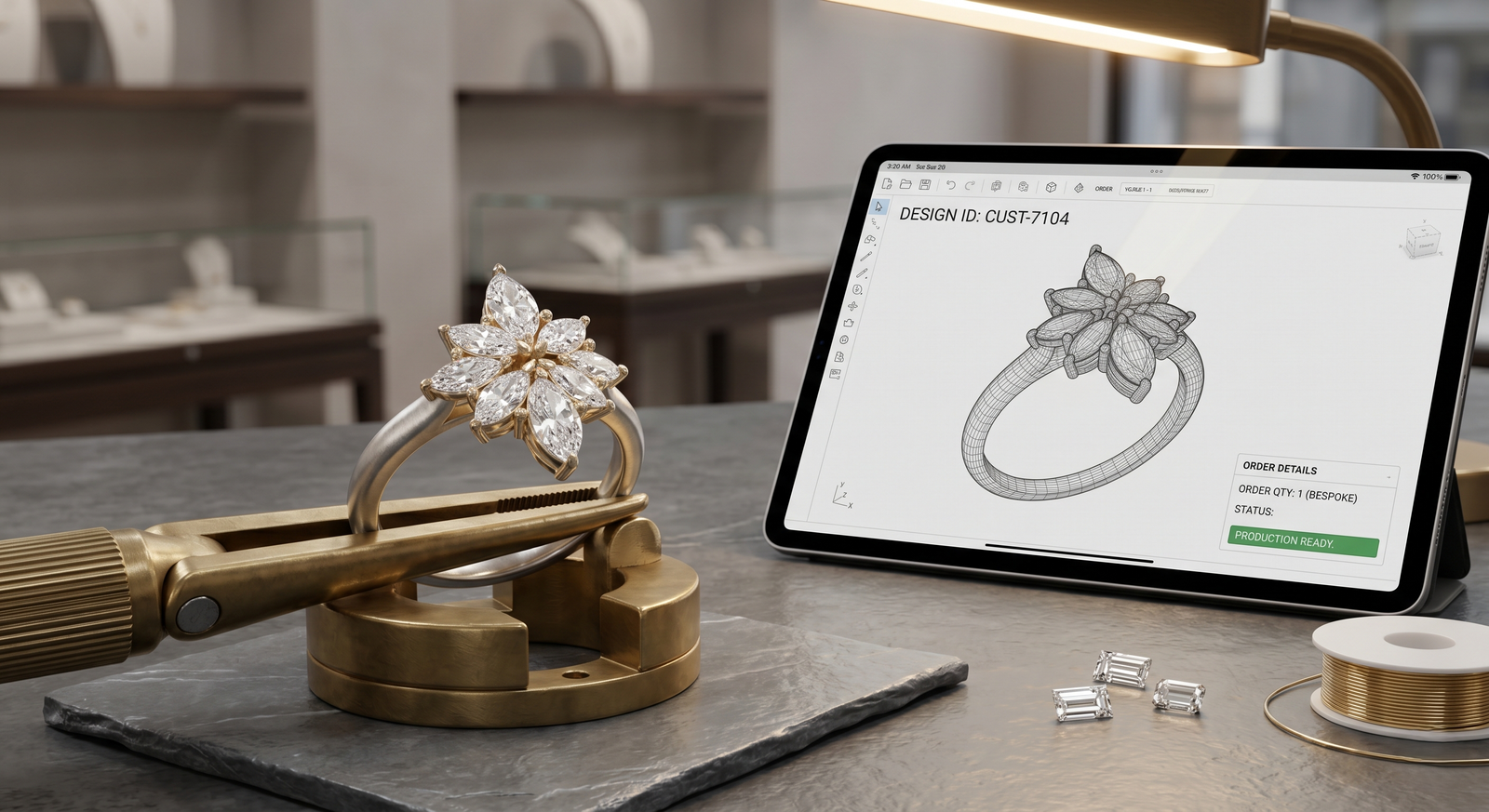
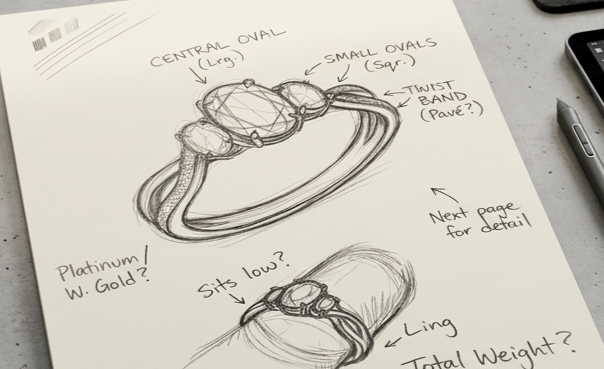
A retailer in Sydney messaged us a few months back — the kind of first message any wholesale diamond jewellery supplier ends up getting a lot. Just a photo of a sketch, nothing fancy. Their customer wanted an engagement ring done a certain way — 2 carat centre stone, 14k white gold, two side stones. We had it turned into a CAD design within 24 hours, and they placed the order not long after.

Stuff like that is usually what convinces a new Australian retailer to actually work with us, instead of just poking around the catalogue. We’re not new to this. 31 years in natural diamonds as a family business, lab-grown added to the workshop in 2019 once it was obvious where demand was heading. But honestly, the thing that seems to surprise people most isn’t the years in the business — it’s that when we say no minimum order, we mean it. Samples aren’t free, there’s a small premium on those, but past that? Order one piece if that’s all you need. Two. Whatever the job calls for. That’s the difference between calling yourself a wholesale diamond jewellery supplier and actually being one.

Why Lab-Grown Is No Longer the “Alternative” Option

We’ve watched this shift happen up close. A few years ago retailers treated lab-grown like a special order. Now it’s just there, on the same shelf as natural, without much distinction drawn between the two anymore. Makes sense once you think about it — chemically and optically it’s the same diamond, certified to the same standard, and the customer gets more stone for their money. That’s dragged lab-grown well past engagement rings: tennis bracelets, studs, stackable rings, the stuff people buy for themselves rather than for an occasion.

Two things follow from that if you’re a retailer. Customers now expect to see both types side by side, not one tucked away as the “budget” option. And because lab-grown costs less to produce, buying direct from a manufacturer instead of through a couple of middlemen means you can price competitively and still keep your margin.

What Customers Are Actually Asking For: Custom Over Catalogue

That Sydney ring is a decent example of something we see constantly now. Nobody wants “something like this” pulled off a catalogue page anymore. They want their own idea made real — a proposal story, an old family design reworked for someone new, a piece that doesn’t look like what their mate already has.

Which is exactly why MOQs have turned into such a headache industry-wide. Most manufacturers still want a big batch commitment before they’ll even look at a custom design. So retailers end up stuck: turn the customer away, or gamble on volume for something nobody’s tested yet.

No MOQ: Why It’s Worth Checking With Any Wholesale Diamond Jewellery Supplier

This bit’s worth spelling out clearly, because it tends to matter more than almost anything else on a retailer’s checklist. We’ll do custom orders of one or two pieces, not as some technicality with fine print attached. Samples cost a bit extra, and we’re upfront about that from the first message. Past that though, ordering small really is as simple as it sounds, which seems to be the part new retailers trust the least until they’ve placed a first order and seen it play out for themselves.

For anyone building out a private-label or made-to-order range, that flexibility usually ends up being the deciding factor.

What Else to Look for in a Wholesale Diamond Jewellery Supplier

Beyond MOQ and custom work, here’s roughly what we’d tell a retailer to check with any supplier, us included:

  • Independent certificationGIA or IGI reports, with clear disclosure of growth method on every lab-grown piece.
  • A real sampling process. You should be able to see and approve physical samples before a bulk order, not just photos.
  • Time-zone-friendly communication. A supplier with a contact point that overlaps reasonably with Australian business hours is far easier to actually work with.
  • Export experience. Familiarity with shipping certified diamond jewellery internationally, including the paperwork that comes with it.

Why Surat, India Leads Global Diamond Manufacturing

Surat cuts and polishes most of the world’s diamonds at this point, natural and lab-grown both, and it’s where our workshop sits too. For buyers in Australia that mostly comes down to three things: craftsmanship built up over generations, enough manufacturing capacity to handle a one-off custom piece or a bigger order without much fuss, and pricing that reflects making things at the source instead of paying for two or three markups along the way.

The worry people sometimes raise — can you actually communicate reliably across that distance — really comes down to who you’re working with, not where they’re based. Export experience and a contact point in a workable time zone sorts most of that out.

Oberon Jewels: A Wholesale Diamond Jewellery Supplier for Australian Retailers

We make and supply both lab-grown and natural diamond jewellery wholesale, based in Surat, with someone on the ground in New York for anyone working Western hours. A few things worth knowing if you’re an Australian retailer looking us up:

  • No MOQ, and we mean that literally. One or two pieces is fine to start.
  • Custom and private-label work isn’t a special add-on, it’s most of what we do. Send a sketch, a photo, even just a description, and we’ll get a CAD back, usually inside 24 hours.
  • Natural and lab-grown, both made in-house, so you’re not juggling two suppliers for one assortment.
  • Wholesale-only pricing. We don’t sell to individual buyers, so there’s no retail markup baked in.

Turnaround: What to Actually Expect

Once an order’s confirmed, it’s 8 to 9 business days for production, then another 7 or 8 for shipping to Australia. Call it three weeks, roughly, confirmation to delivery. The CAD side moves faster — the Sydney ring, for instance, was approved within a day of us getting the sketch.

Frequently Asked Questions

Does Oberon Jewels have a minimum order quantity (MOQ)? No, and we get asked this a lot because people assume there’s a catch somewhere. There isn’t. One or two pieces is genuinely fine. The only cost beyond the piece itself is a small premium on samples.

How long does an order take? 8–9 business days to produce once confirmed, then roughly 7–8 business days shipping to Australia. So around three weeks door to door for a first order.

How long has Oberon Jewels been in business? 31 years in natural diamonds as a family business. We brought lab-grown into the workshop in 2019.

Is Oberon Jewels a manufacturer or a supplier? Both, really. We’re a wholesale diamond jewellery supplier and a manufacturer combined — everything’s designed, cast and finished in-house in Surat, then supplied straight to retailers and distributors, no extra layers in between.

Does Oberon Jewels manufacture both lab-grown and natural diamond jewellery? Yes, both come out of the same workshop, so you can mix your assortment through one supplier instead of splitting it across two.

Can Australian retailers get custom or private-label designs made? Yes — it’s not a special request, it’s most of the work we do. Send your own design or a customer’s sketch, or start from something in our catalogue and change it up.

Does Oberon Jewels ship to Australia? Yes — Australia, the US, Canada and the UK.


Got a sketch, a photo, or just a rough idea for something custom? We’re a wholesale diamond jewellery supplier that’ll actually do the small order — get in touch for a catalogue and sample pricing, or browse the full range on our site.

Why ‘No MOQ’ Custom Diamond Jewelry Manufacturing Is a Game Changer for Independent Retailers

Working with a custom jewelry manufacturer with no MOQ is one of the most powerful advantages an independent retailer can have in 2025. For years, minimum order quantities locked small businesses out of bespoke manufacturing — forcing them to carry generic inventory or over-commit to designs before knowing if they would sell. At Oberon Jewels, we eliminated that barrier entirely. Whether you need one piece or one thousand, we manufacture to your exact specifications with zero minimums.

What Does ‘No MOQ’ Actually Mean?

No minimum order quantity means you can order a single piece — one ring, one pair of earrings, one bracelet — and receive it manufactured to your exact specifications. You are not required to commit to large inventory runs before you know whether a design will sell.

For custom diamond jewelry, this means you can:

  • Test a new design with just 1–3 pieces before scaling
  • Offer bespoke made-to-order pieces directly to your retail customers
  • Build a private label collection without the financial risk of bulk buying
  • React to trends quickly — order new designs as they emerge, not months in advance

How Custom Manufacturing Works (From Sketch to Showcase)

Modern jewelry manufacturers have eliminated the friction that once made custom orders complicated. At Oberon Jewels, the process looks like this:

  • Submit your design — a sketch, reference photo, or existing CAD file. No technical experience required.
  • CAD modelling — our designers create a precise 3D model and share it for your approval before any metal is cast.
  • Material selection — choose your metal (10K, 14K or 18K white, yellow, or rose gold), diamond type (lab grown CVD, HPHT, or natural), and specifications.
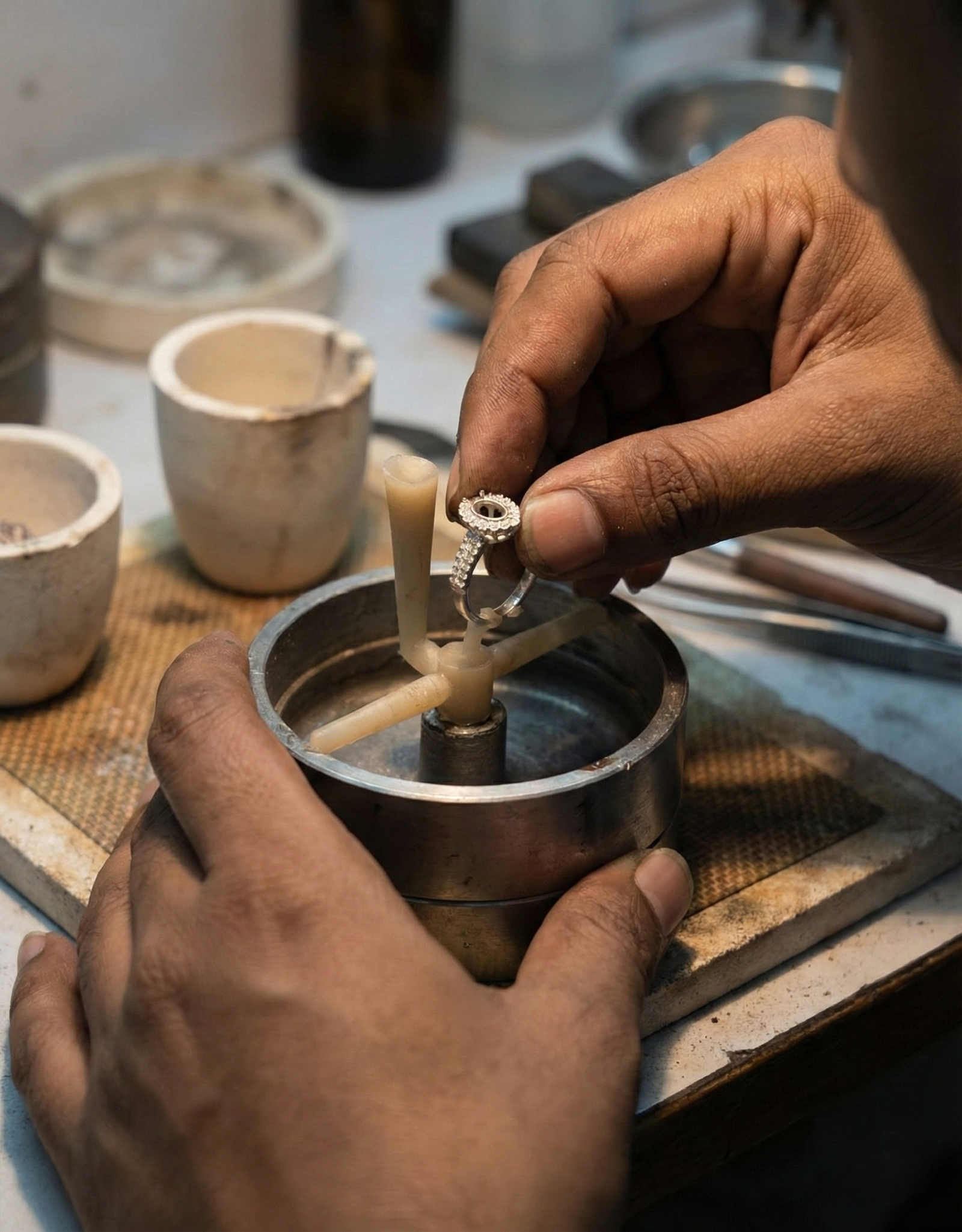
  • Casting and setting — using vacuum casting for zero porosity and hand-setting by master artisans under microscopes.
  • Quality control — a 10-point inspection before shipping, covering every prong, surface, and stone.

Lightweight Design: The Advantage Your Customers Do Not See but Feel in the Price

Our specialty at Oberon Jewels is lightweight fine jewelry — engineered to use the minimum gold weight required to achieve the desired aesthetic and structural integrity. This is not a shortcut; it is precision engineering. Through this expertise, we have helped 70+ clients improve their margins and scale their business profitably — a trust reflected in their continued partnerships and repeat orders.

The benefit to you as a retailer: lower manufacturing cost per piece, which means better margins, more competitive retail pricing, or both. A customer comparing your 14K gold diamond ring to a competitor’s identical-looking piece will not know yours weighs 0.8 grams less — they will simply see a better price.

Who Benefits Most from a Custom Jewelry Manufacturer with No MOQ

  • Independent jewelry stores wanting exclusive designs their local competitors do not carry
  • Online jewelry brands building a private label collection
  • Designers who have CAD files but no manufacturing relationship
  • Existing retailers expanding into diamond jewelry from fashion or silver jewelry
  • Gift and lifestyle stores wanting a curated, small-batch fine jewelry offering

Getting Started with Oberon Jewels

We manufacture custom lab grown and natural diamond fine jewelry for retailers and brands across the USA, UK, Australia, Canada, New Zealand, and Brazil. No minimum order quantity. IGI/GIA/HRD certified diamonds. Lightweight construction. Competitive wholesale pricing.

To request a quote or discuss your custom project, use our Custom Manufacturing form on the website or contact our wholesale team at info@oberonjewels.com. We respond within 24 hours.

Lab Grown vs Natural Diamonds: What Every Jewelry Retailer Needs to Know in 2026

The debate between lab grown vs natural diamonds is reshaping jewelry retail worldwide. If you are a store owner in the USA, Australia, UK, or Canada deciding what to stock in 2025, this guide gives you the honest, practical picture — covering price, customer demand, certification, and how to source both profitably.

The Basics: What Is a Lab Grown Diamond?

A lab grown diamond is a real diamond. It has the same chemical composition (pure carbon), the same crystal structure, and the same optical and physical properties as a mined diamond. The difference is origin: lab grown diamonds are created in a controlled environment using either CVD (Chemical Vapor Deposition) or HPHT (High Pressure High Temperature) technology, rather than forming over billions of years underground.

Both IGI and GIA — the world’s most trusted gemological laboratories — grade and certify lab grown diamonds using the same 4Cs system as natural diamonds: cut, colour, clarity, and carat.

Price: The Most Important Factor for Retailers

Lab grown diamonds typically retail at 60–80% less than mined diamonds of equivalent quality. For your customers, this means significantly more diamond for their budget. For you as a retailer, it means:

  • Higher unit sales volume — more customers can afford fine diamond jewelry
  • Attractive price points for gifting, everyday wear, and fashion jewelry categories
  • Ability to compete online without racing to the bottom on margin

Wholesale prices for lab grown diamonds have continued to decrease as technology scales — making now an ideal time to establish supplier relationships before the market becomes more competitive at retail level.

What Customers Are Actually Asking For

Consumer research consistently shows that younger buyers — particularly millennials and Gen Z — place high value on ethical sourcing and sustainability. Lab grown diamonds answer both: no mining, no environmental disruption, and a verifiable origin. In markets like California, New York, London, and Sydney, leading with ‘lab grown’ is increasingly a competitive advantage, not a compromise.

At the same time, bridal and heritage customers often still prefer natural diamonds. The retailers performing best are those who offer both — letting the customer choose based on their values and budget.

At Oberon Jewels, we craft both natural and lab-grown diamond jewelry with precision finishing and premium quality—so your customers get the same luxury, brilliance, and craftsmanship, no matter their choice.

Lab Grown vs Natural Diamonds: Practical Considerations for Retailers

  • Certification is non-negotiable. Only stock lab grown diamonds with IGI or GIA certificates. Uncertified stones create liability and erode customer trust.
  • Educate your staff. The biggest barrier to lab diamond sales is salespeople who are unsure how to explain them. Train your team to answer the basic questions confidently.
  • Display them equally. Keeping lab grown diamonds in a separate, less prominent case signals they are inferior. They are not. Treat them as equals.
  • Pricing strategy. Some retailers price lab grown diamonds based on a percentage below natural diamond. Others price on value delivered. Test both approaches with your customer base.

Sourcing Lab Grown Diamonds for Your Store

The most cost-effective way to source lab grown diamond jewelry is direct from a manufacturer — not through a domestic distributor who adds margin at every step. Surat, India is the global center of lab grown diamond manufacturing, combining cutting expertise, modern technology, and competitive wholesale pricing.

Oberon Jewels supplies certified lab grown and natural diamond jewelry wholesale to retailers in the USA, UK, Australia, Canada, New Zealand, and Brazil. We offer no minimum order quantities, so you can introduce lab grown diamonds to your collection without financial risk. Contact us to receive our wholesale catalogue.

How to Source Lab Grown Diamond Jewelry from India: A Guide for Retailers

Finding a reliable lab grown diamond manufacturer in India is one of the smartest sourcing decisions a jewelry retailer can make. Surat — India’s diamond city — produces over 90% of the world’s cut and polished diamonds, and today that same infrastructure delivers world-class lab grown diamond jewelry at a fraction of the cost of Western equivalents. This guide walks you through exactly how to source responsibly, what to look for, and the questions you must ask before placing your first order.

This guide walks you through exactly how to source responsibly, what to look for in a manufacturer, and the questions you must ask before placing your first order.

Why Choose a Lab Grown Diamond Manufacturer in India

Surat has been a center of diamond craftsmanship for over a century. The city’s artisans combine generations of hand-setting expertise with modern CAD technology, vacuum casting, and microscope-guided stone setting. For lab grown diamonds specifically, India’s manufacturing infrastructure — lower labor costs, established trade routes, and proximity to raw material suppliers — means wholesale pricing that European or American manufacturers simply cannot match.

For retailers, sourcing from an Indian manufacturer means: better margins on every piece sold, access to far greater design variety, and the ability to offer custom pieces your competitors do not carry.

What to Look for in a Lab Grown Diamond Jewelry Manufacturer

Not all Indian manufacturers are equal. Here is what separates a reliable wholesale partner from a frustrating one:

  • Certification: Every lab grown diamond should come with an IGI, GIA, or HRD grading report. Do not accept uncertified stones, no matter how low the price.
  • Manufacturing capability: Look for in-house CAD design, casting, hand-setting, and quality control. A manufacturer who outsources key steps cannot guarantee consistency.
  • No MOQ flexibility: If a manufacturer requires you to order 50 or 100 pieces of the same design, they are not set up for the modern retail market. The best manufacturers offer no minimum order quantities so you can test designs before committing.
  • Lightweight design expertise: Lighter jewelry means lower gold weight, which translates directly to better retail pricing. Ask if your manufacturer specializes in lightweight construction.
  • Export experience: Confirm they have experience shipping to your market with proper customs documentation, hallmarking, and insured international shipping.

The Sourcing Process: Step by Step

  • Step 1 — Define your product range. Decide which categories you want to carry: engagement rings, tennis bracelets, stud earrings, necklaces? Knowing your focus helps manufacturers recommend relevant inventory.
  • Step 2 — Request a catalogue and wholesale price list. Reputable manufacturers maintain an online catalogue or can share one on request. Look for transparent pricing in USD.
  • Step 3 — Order samples. Before placing a wholesale order, order individual pieces across your chosen categories. Evaluate craftsmanship, finishing, stone security, and how pieces photograph.
  • Step 4 — Confirm certifications. Request copies of IGI/GIA certificates for your sample pieces. Check them on the certification body’s website.
  • Step 5 — Negotiate terms. Discuss pricing tiers, lead times, custom manufacturing options, and payment terms. A good manufacturer will be transparent about all of these.

Why Oberon Jewels

Oberon Jewels is a Surat-based fine jewelry manufacturer specializing in lab grown diamond and natural diamond jewelry for global retailers. We offer no minimum order quantities, IGI/GIA/HRD certified stones, custom manufacturing from CAD or sketch, and wholesale pricing for independent stores and large buyers alike. Our lightweight jewelry designs are engineered specifically to improve your margins — less gold weight, same luxury aesthetic, better price point for your customers.

We export directly to retailers across the USA, UK, Australia, Canada, New Zealand, and Brazil. Contact our wholesale team to request our catalogue and sample pricing.