
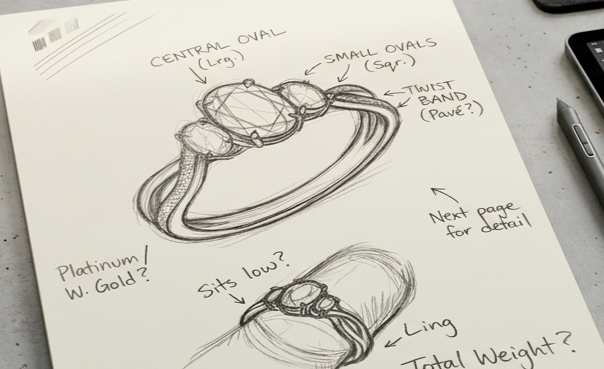
A retailer in Sydney messaged us a few months back — the kind of first message any wholesale diamond jewellery supplier ends up getting a lot. Just a photo of a sketch, nothing fancy. Their customer wanted an engagement ring done a certain way — 2 carat centre stone, 14k white gold, two side stones. We had it turned into a CAD design within 24 hours, and they placed the order not long after.
Stuff like that is usually what convinces a new Australian retailer to actually work with us, instead of just poking around the catalogue. We’re not new to this. 31 years in natural diamonds as a family business, lab-grown added to the workshop in 2019 once it was obvious where demand was heading. But honestly, the thing that seems to surprise people most isn’t the years in the business — it’s that when we say no minimum order, we mean it. Samples aren’t free, there’s a small premium on those, but past that? Order one piece if that’s all you need. Two. Whatever the job calls for. That’s the difference between calling yourself a wholesale diamond jewellery supplier and actually being one.
Why Lab-Grown Is No Longer the “Alternative” Option
We’ve watched this shift happen up close. A few years ago retailers treated lab-grown like a special order. Now it’s just there, on the same shelf as natural, without much distinction drawn between the two anymore. Makes sense once you think about it — chemically and optically it’s the same diamond, certified to the same standard, and the customer gets more stone for their money. That’s dragged lab-grown well past engagement rings: tennis bracelets, studs, stackable rings, the stuff people buy for themselves rather than for an occasion.
Two things follow from that if you’re a retailer. Customers now expect to see both types side by side, not one tucked away as the “budget” option. And because lab-grown costs less to produce, buying direct from a manufacturer instead of through a couple of middlemen means you can price competitively and still keep your margin.
What Customers Are Actually Asking For: Custom Over Catalogue
That Sydney ring is a decent example of something we see constantly now. Nobody wants “something like this” pulled off a catalogue page anymore. They want their own idea made real — a proposal story, an old family design reworked for someone new, a piece that doesn’t look like what their mate already has.
Which is exactly why MOQs have turned into such a headache industry-wide. Most manufacturers still want a big batch commitment before they’ll even look at a custom design. So retailers end up stuck: turn the customer away, or gamble on volume for something nobody’s tested yet.
No MOQ: Why It’s Worth Checking With Any Wholesale Diamond Jewellery Supplier
This bit’s worth spelling out clearly, because it tends to matter more than almost anything else on a retailer’s checklist. We’ll do custom orders of one or two pieces, not as some technicality with fine print attached. Samples cost a bit extra, and we’re upfront about that from the first message. Past that though, ordering small really is as simple as it sounds, which seems to be the part new retailers trust the least until they’ve placed a first order and seen it play out for themselves.
For anyone building out a private-label or made-to-order range, that flexibility usually ends up being the deciding factor.
What Else to Look for in a Wholesale Diamond Jewellery Supplier
Beyond MOQ and custom work, here’s roughly what we’d tell a retailer to check with any supplier, us included:
- Independent certification — GIA or IGI reports, with clear disclosure of growth method on every lab-grown piece.
- A real sampling process. You should be able to see and approve physical samples before a bulk order, not just photos.
- Time-zone-friendly communication. A supplier with a contact point that overlaps reasonably with Australian business hours is far easier to actually work with.
- Export experience. Familiarity with shipping certified diamond jewellery internationally, including the paperwork that comes with it.
Why Surat, India Leads Global Diamond Manufacturing
Surat cuts and polishes most of the world’s diamonds at this point, natural and lab-grown both, and it’s where our workshop sits too. For buyers in Australia that mostly comes down to three things: craftsmanship built up over generations, enough manufacturing capacity to handle a one-off custom piece or a bigger order without much fuss, and pricing that reflects making things at the source instead of paying for two or three markups along the way.
The worry people sometimes raise — can you actually communicate reliably across that distance — really comes down to who you’re working with, not where they’re based. Export experience and a contact point in a workable time zone sorts most of that out.
Oberon Jewels: A Wholesale Diamond Jewellery Supplier for Australian Retailers
We make and supply both lab-grown and natural diamond jewellery wholesale, based in Surat, with someone on the ground in New York for anyone working Western hours. A few things worth knowing if you’re an Australian retailer looking us up:
- No MOQ, and we mean that literally. One or two pieces is fine to start.
- Custom and private-label work isn’t a special add-on, it’s most of what we do. Send a sketch, a photo, even just a description, and we’ll get a CAD back, usually inside 24 hours.
- Natural and lab-grown, both made in-house, so you’re not juggling two suppliers for one assortment.
- Wholesale-only pricing. We don’t sell to individual buyers, so there’s no retail markup baked in.
Turnaround: What to Actually Expect
Once an order’s confirmed, it’s 8 to 9 business days for production, then another 7 or 8 for shipping to Australia. Call it three weeks, roughly, confirmation to delivery. The CAD side moves faster — the Sydney ring, for instance, was approved within a day of us getting the sketch.
Frequently Asked Questions
Does Oberon Jewels have a minimum order quantity (MOQ)? No, and we get asked this a lot because people assume there’s a catch somewhere. There isn’t. One or two pieces is genuinely fine. The only cost beyond the piece itself is a small premium on samples.
How long does an order take? 8–9 business days to produce once confirmed, then roughly 7–8 business days shipping to Australia. So around three weeks door to door for a first order.
How long has Oberon Jewels been in business? 31 years in natural diamonds as a family business. We brought lab-grown into the workshop in 2019.
Is Oberon Jewels a manufacturer or a supplier? Both, really. We’re a wholesale diamond jewellery supplier and a manufacturer combined — everything’s designed, cast and finished in-house in Surat, then supplied straight to retailers and distributors, no extra layers in between.
Does Oberon Jewels manufacture both lab-grown and natural diamond jewellery? Yes, both come out of the same workshop, so you can mix your assortment through one supplier instead of splitting it across two.
Can Australian retailers get custom or private-label designs made? Yes — it’s not a special request, it’s most of the work we do. Send your own design or a customer’s sketch, or start from something in our catalogue and change it up.
Does Oberon Jewels ship to Australia? Yes — Australia, the US, Canada and the UK.
Got a sketch, a photo, or just a rough idea for something custom? We’re a wholesale diamond jewellery supplier that’ll actually do the small order — get in touch for a catalogue and sample pricing, or browse the full range on our site.
